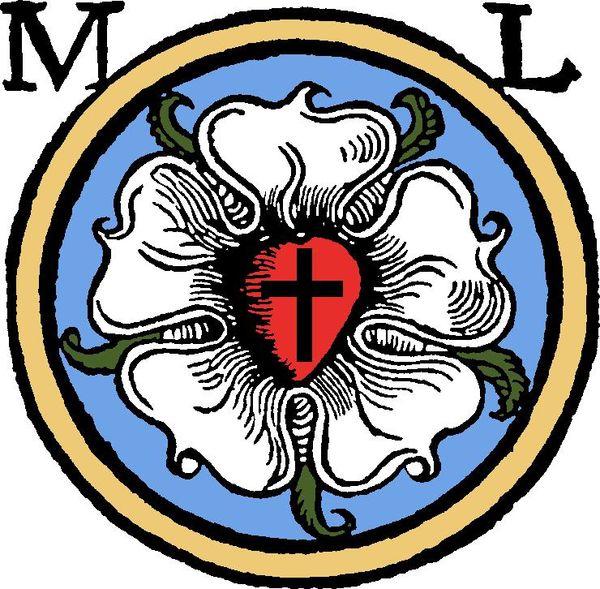
In his letter to Lazarus Spengler dated July 8, 1530, Martin Luther writes the following about the Luther rose, after he had presumably received from Spengler the design of a golden signet ring that the electoral prince and later Elector of Saxony, John Frederick the Magnanimous, had commissioned from an Augsburg or Nuremberg goldsmith:
„But such a heart should stand in the middle of a white rose, to show that faith gives joy, comfort, and peace, and in short places it in a white, cheerful rose. This is not done in the way the world gives peace and joy; therefore the rose shall be white and not red. For the white color is the color of the spirits and all angels. Such a rose stands in a sky-blue field, because such joy in the spirit and in faith is a beginning of the heavenly future joy, which is indeed already included within it and grasped through hope, but is not yet revealed.“ (WA.Br 5, no. 1628)
Botanically, the Luther rose can be identified either as the dog rose or hedge rose (Rosa canina) or as the burnet rose (Rosa spinosissima). In both, the flowers have five petals. That the dog rose can also produce white flowers is evident in our parish garden. Since the dog rose is by far the most common wild-growing species of the genus Rosa in Central Europe and its well-known rose-hip fruits are red—in contrast to the black to purple-black rose hips of the burnet rose—I assume that, botanically speaking, the Luther rose is a dog rose or hedge rose.
The research was initiated by Rose Chue, who lives at the Lutheran Theological Seminary in Hong Kong and would like to establish a Luther rose garden there. We shall see whether a Luther rose grows in Hong Kong from our rose-hip seeds.


